
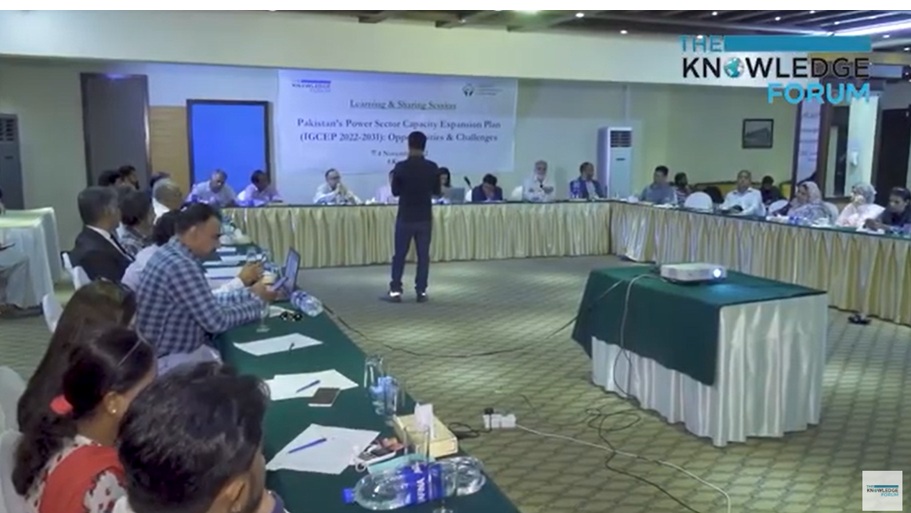
The Knowledge Forum (TKF) organized a learning and sharing session titled “Pakistan’s Power Sector Capacity Expansion Plan (IGCEP 2022-2031): Opportunities and Challenges” on November 4, 2022.
The session brought together parliamentarians, energy experts, economists, civil society representatives, and researchers to deliberate on the Indicative Generation Capacity Expansion Plan (IGCEP), a key document outlining Pakistan’s 10-year roadmap for power generation prepared annually by the National Transmission and Dispatch Company (NTDC) and approved by NEPRA after stakeholder consultations.
Participants urged rationalisation of the IGCEP to align it with Pakistan’s international climate commitments and to optimize renewable energy in the national power mix. They noted that the existing emphasis on hydropower and coal projects diverts the country from its Paris Agreement goals and recommended greater integration of solar and wind energy to replace fossil fuels.
Energy expert Zain Mouvli of Alternative Law Collective explained the technical and political dimensions of the IGCEP process, highlighting the World Bank’s role through the PACE programme in revising Pakistan’s renewable targets downward. He emphasized the need for transparency and inclusion of civil society voices in the IGCEP review process.
Member National Assembly Dr. Shahida Rehmani, a member of the National Assembly’s Standing Committee on Climate Change, stressed that Sindh’s contribution to the national energy mix must be recognized, noting that energy and gas produced in Sindh supply other provinces. She called for policies that reflect provincial perspectives.
Senior economist Prof. Ejaz Qureshi opposed construction of additional dams on the Indus River and underlined the importance of strengthening electricity distribution networks. Civil society activist Zulfiqar Halepoto appreciated Sindh’s stance on IGCEP and urged the provincial government to assert its position at the federal level.
Other speakers, including Dr. Raza Ali Khan of NED University and Zahid Farooq of Urban Resource Centre, called for participatory consultations and provincial-level IGCEP hearings to ensure inclusive decision-making.
Sarah Zaman, feminist researcher, highlighted the underrepresentation of women in the energy sector, where they constitute less than 6% of the workforce, and noted the disproportionate impact of energy shortages on women and marginalized groups.
Saeed Baloch and Zulfiqar Shah urged policy alignment with climate goals and emphasized replacing coal-based projects with renewables. In conclusion, participants collectively called for democratizing the IGCEP process, ensuring policy continuity, and prioritizing clean, equitable, and sustainable energy solutions for Pakistan.


