
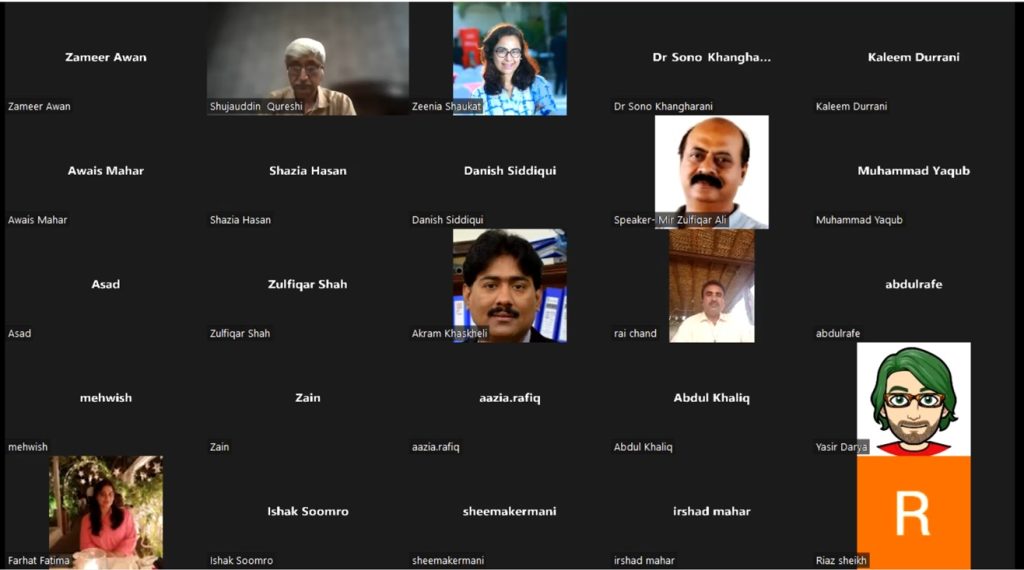
The Knowledge Forum organised a Webinar on “Assessing Provincial Picture of Flooding in Pakistan – Dispatches from Sindh on August 29, 2022, to assess the true picture of flooding in all the provinces of Pakistan, in which speakers highlighted the plight of rain-hit people across the province.
They said that the government was showing a smaller number of flood-affected people, as around 10 million people had been affected due to the floods in Sindh alone.
However, they also agreed that it was premature to say anything about the intensity and impact of the flood since floodwaters were still coming.
Speaking at the event, social activist Jan Odhano said that Sindh, besides dealing with its own flooding, is also getting the brunt of the flooding in Balochistan.
“The districts of Sindh bordering Balochistan had their own rainwater flooding the area, but now a new situation has developed where they are hit by the flash floods from Balochistan too. And it is all affecting land, crops, livestock and the livelihood of people,” he said, adding that 90 per cent of the rice crop had been ruined, clay and straw homes had collapsed, and where the homes had RCC roofs, they were also unlivable because they were flooded.
Development expert Dr Sono Khanghrani thought that it was still premature to assess the intensity and impact of the floods as the waters were still coming.
“Still, if you compare the 2011 rains millimetre-wise with these rains, the rain was less in 2011. But this time there is the mismanagement factor with landlords and people doing as they feel, making cuts in drains, digging ditches, etc, wherever they feel like,” he said.
Akram Khaskheli of the Hari Welfare Association said that the flood drains were also not strong enough, due to which they developed breaches. “That is also why people didn’t get time to move their animals as they drowned,” he said.
He also pointed out that government estimates regarding losses due to the floods are not correct.
Radha Bheel of the Pakistan Dalit Solidarity Network, who works with scheduled castes, said that the scheduled castes work in agriculture, so they are the worst hit by the floods, as the crops have been ruined.
“These people could only save their children when the floods came, and they had to run to save their lives,” she said.
Other speakers included Dr Riaz Sheikh of Szabist, Uzma Noorani of the Human Rights Commission of Pakistan, Mohammed Yaqoob of Takhliq Foundation, Yasir Husain of Darya Lab, Zeenia Shaukat and Shujauddin Qureshi of the TKF.


