
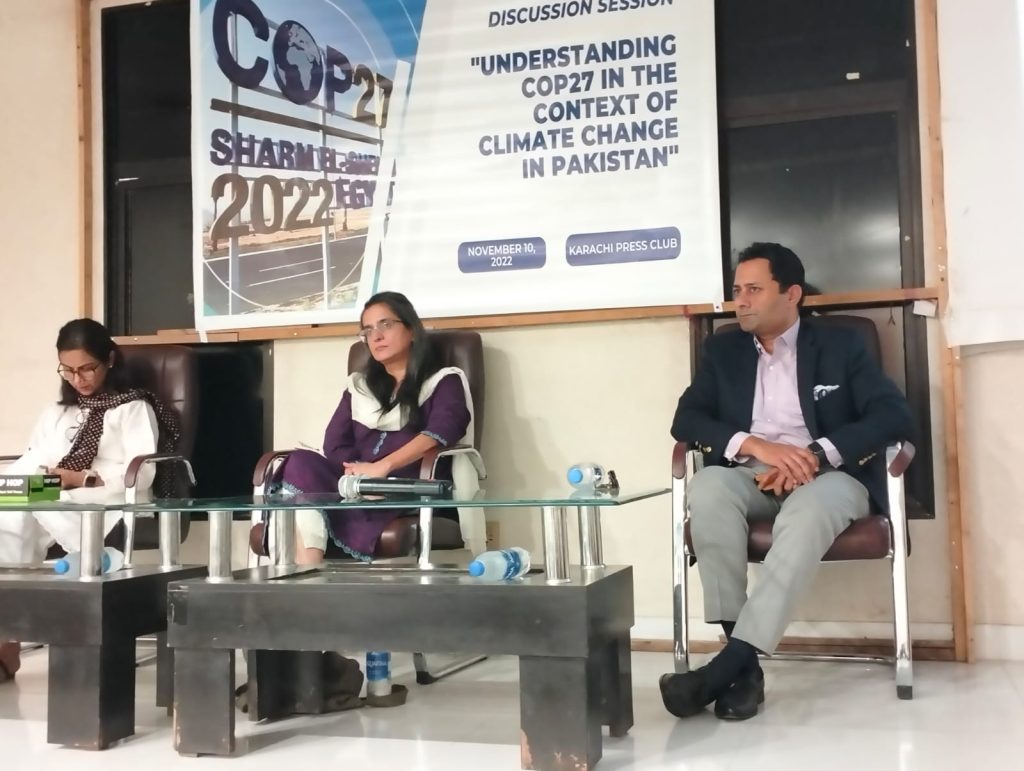
The Knowledge Forum (TKF) organised a discussion session titled “Understanding COP27 in the Context of Climate Change in Pakistan” at the Karachi Press Club on November 10, 2022. The session brought together academics, civil society members, students, and climate activists who urged Pakistan to adopt a more assertive stance at the global level, particularly in demanding climate reparations and debt relief from major polluting nations responsible for the climate crisis.
Speakers emphasised that developed countries must end their double standards — speaking about combating climate change while continuing to pollute the planet. They noted that Pakistan, among the top ten countries most vulnerable to climate change, has been suffering from recurrent climate-induced disasters, including the recent catastrophic floods.
Dr Aqdas Afzal of Habib University stressed that Pakistan should forcefully seek reparations rather than adopting an apologetic tone at international forums. He called for establishing a Global Reparation Secretariat in a developing country to address climate-induced losses and damages.
Dr Afzal also proposed that international financial institutions like the IMF and World Bank revisit their lending conditions and provide debt relief on Pakistan’s $94 billion debt in recognition of climate realities. He further recommended increasing flood relief assistance under BISP from Rs. 25,000 to Rs. 100,000 and waiving electricity bills for at least three months in the 19 poorest flood-affected districts.
Muhammad Mustafa Amjad, Programme Manager at The Renewables First, in his online presentation, highlighted that COP27 marks the first time Pakistan’s participation has been proactive and visible in the global climate discourse. He underscored the need to shift towards nature-based and clean energy solutions, urging a global commitment to end fossil fuel dependency.
Ms Abira Ashfaq of the Karachi Bachao Tehreek and faculty at IBA emphasised that internal climate injustices must be addressed alongside international advocacy. She cited the displacement of over 1.2 million people from Badin due to climate change and flawed development projects such as LBOD. She called for genuine environmental impact assessments, special housing schemes for climate migrants, and inclusion of affected communities in policy consultations.
The session concluded with a call for Pakistan to present its case for climate reparations assertively at international platforms and to integrate local voices into national climate policies. The discussion was moderated by Ms Zeenia Shaukat, Director of The Knowledge Forum.


