
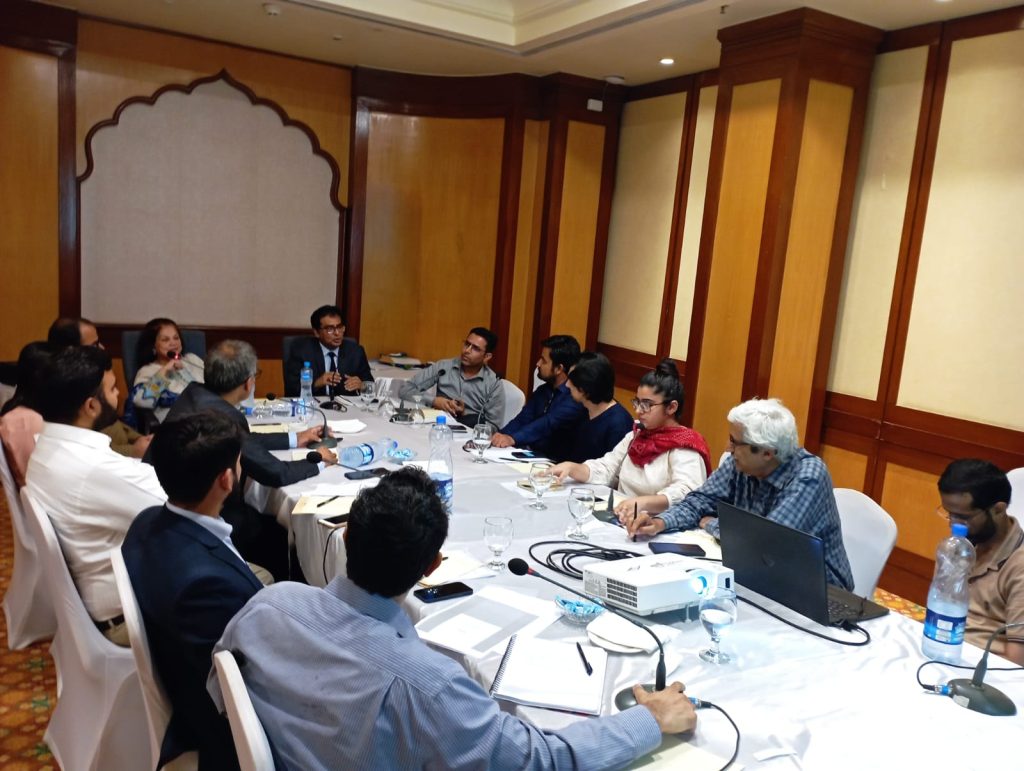
The Knowledge Forum (TKF) organised a briefing session on Sindh’s progress toward energy self-sufficiency through renewable resources at a hotel in Karachi on June 16, 2022, where Mr Abu Bakar Ahmed Madni, Secretary, Energy Department, Government of Sindh, gave a presentation and highlighted the province’s commitment to diversifying its energy mix.
The session was attended by representatives from civil society organisations, including the Alliance for Climate Justice and Clean Energy (ACJCE) and the Renewable Energy Coalition (REC).
Mr. Madni informed participants that Sindh was currently generating 1,235 MW of power through 24 wind-based independent power producers (IPPs), while another 610 MW are under construction through 12 additional projects, including 300 MW being developed by Chinese consortiums under CPEC. He stated that Sindh’s Jhimpir-Gharo-Keti Bandar wind corridor alone has a generation potential of up to 55,000 MW, and the province aims to become self-sufficient and capable of exporting surplus energy in the near future.
To facilitate renewable energy development, Sindh has issued 61 Letters of Intent (LoIs) for solar, wind, and biomass projects. Over 1,000 acres have been leased to companies for renewable projects, and 40,000 acres have been reserved for renewable energy parks. Mr. Madni also mentioned that Sindh is the first province to have established its own Sindh Transmission and Dispatch Company (STDC). The first 95 km, 132 kV double circuit transmission line from Nooriabad to Karachi was completed in 2018 for Rs 2 billion and is transmitting 100 MW to Karachi Electric.
In the solar sector, the Secretary shared that Sindh has implemented several off-grid projects between 2014 and 2016, including the electrification of 350 schools in Nangarparkar, 140 houses in Sanghar, and five villages in Ghotki. Presently, additional solar projects generating 150 MW are under construction.
Discussing coal power, Mr Madni noted that two 330 MW plants at Thar Block-2 are operational and connected to the national grid. A 250 km, 500 kV transmission line from Thar to Matiari has been laid for Rs 22.3 billion. Work is also underway to dedicate a sixth Thar block for coal gasification. The government plans to gradually replace imported coal with Thar coal using a 20:80 ratio to conserve foreign exchange.
Ms. Anis Haroon, Member, National Commission for Human Rights, urged the government to address community concerns in Thar and to enhance focus on solar energy. Earlier, Ms Zeenia Shaukat of TKF welcomed participants and emphasised civil society’s role in promoting renewable energy in Pakistan.


