
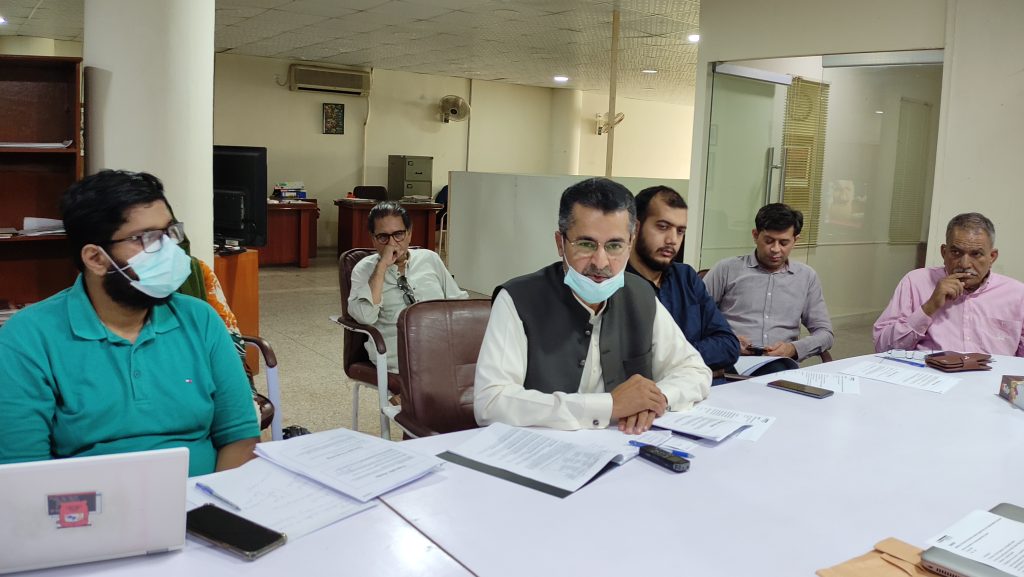
The Knowledge Forum organised a consultation on “Review of the Sindh Climate Change Policy and Implementation Framework” in cooperation with the National Commission for Human Rights at its Karachi Office on April 15, 2022.
Environmental experts, climate change activists, lawyers, journalists and civil society, as well as rights activists, attended the consultation. They called upon the provincial government to make the Sindh Climate Change Policy people-centric and include an effective implementation mechanism for mitigating the environmental challenges people in both rural and urban areas are facing.
Member of NCHR (from Sindh) Ms. Anis Haroon presided over the meeting, while prominent among the participants were senior trade unions leader Habibuddin Junaidi, Director of Sindh Environmental Protection Agency Waqar Hussain Phulpoto, senior urban planner M. Toheed, Additional Secretary, Energy Department Dr. Abdul Shakoor Abro, Director of Aurat Foundation Mahnaz Rahman, a member of Sindh Human Rights Commission Zulfiqar Shah, Members of Sindh Human Rights Commission (SHRC) Sub-Committees Sarah Zaman and Pushpa Kumari, Zahid Farooq from Urban Resource Centre, senior lawyer Altaf Hussain Khoso, Maaz Tanveer from HANDS, Abdul Raafe from Alternative Law Collectives, Iram Aijaz from Pakistan Red Crescent, environmental activists Yasir Husain, Basil Andrews and others.
The participants pointed out various missing elements in the policy. They particularly emphasised that the policy does not recognise concretisation and carbon emission-intensive energy generation, such as coal and gas, as problem areas. The ongoing expansion of coal power plants in Tharparkar is likely to lead Pakistan into becoming one of the largest air pollutant, mercury and CO2 emissions hotspots in South Asia.
The participants also mentioned that there is no mention of how to mitigate the heatwave impact in the urban areas, climate financing, the role of District Disaster Management Authorities, etc.
The speakers deplored the recent increase in taxes on the import of solar panels and said that it would discourage the alternative energy source.
Explaining the objectives of the meeting, Zeenia Shaukat from The Knowledge Forum said that the Civil society’s inputs, particularly from the approach of community protection, and identification of technical gaps hindering the community agenda, are crucial to ensuring the policy is representative and responsive to the impact of climate change experienced by common citizens.
The impact of climate change is documented to be more severe in Sindh, compared to other parts of the country. The mean daily temperatures in Sindh province are projected to increase by about 5°C during the 21st century, while climatic patterns such as increasing incidences of droughts, heatwaves, air pollution due to the rapid urbanisation and industrialisation, and water insecurity are predicted to become more common in coming years.


