
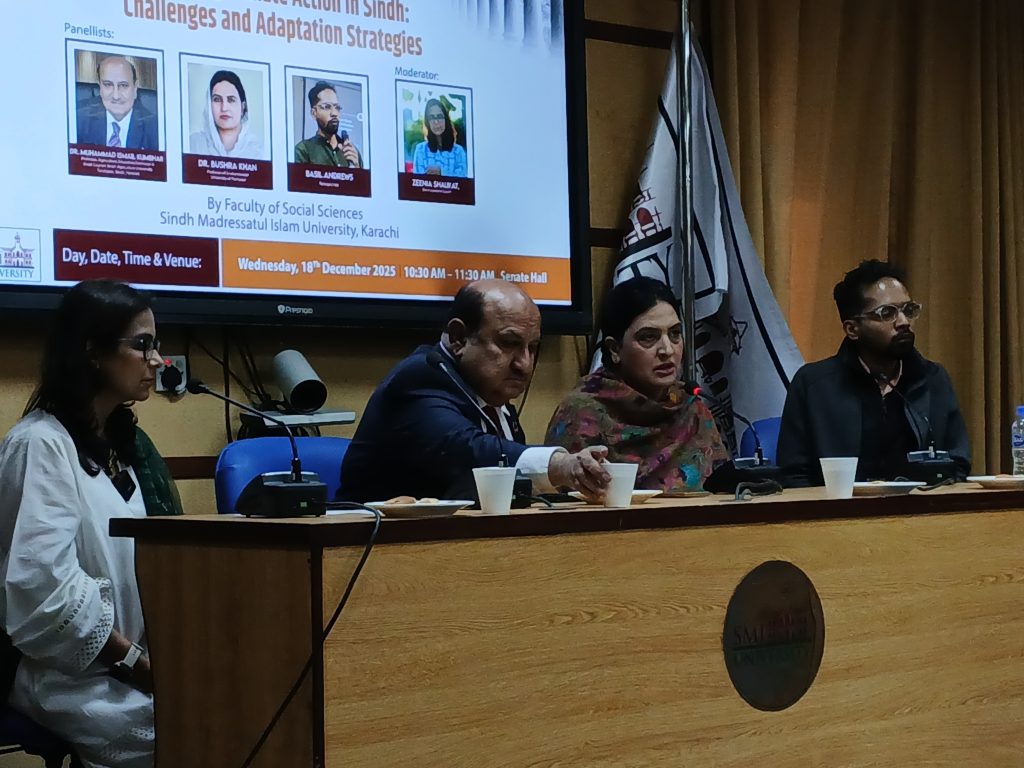
The Knowledge Forum (TKF) and Sindh Madressatul Islam University jointly organised a panel discussion titled “Localising Climate Action in Sindh: Challenges and Adaptation Strategies,” at SMIU, Karachi on December 18, 2025.
Environmental experts, academics and researchers participating in the discussion stressed the importance of adopting indigenous knowledge and community-based solutions to address the growing impacts of climate change in Pakistan, particularly in Sindh.
The panel featured Prof Dr Muhammad Ismail Kumbhar of Sindh Agriculture University, Tando Jam; Dr Bushra Khan, Chairperson of the Department of Environmental Science at the University of Peshawar; journalist and researcher Basil Andrews; and Ms Zeenia Shaukat, Director of The Knowledge Forum.
Speaking on the occasion, Dr Kumbhar highlighted the severe impact of changing weather patterns on agriculture, livelihoods and the economy. He said rising temperatures and sea intrusion in the Indus Delta had damaged agricultural land and reduced crop productivity. Referring to the 2022 floods, he noted that millions of people were affected and significant losses were caused to crops, livestock and infrastructure.
He said recurrent heatwaves, urban flooding and water scarcity were becoming major challenges in Sindh and stressed the need for practical implementation of climate policies. He also called for climate-smart agriculture and the revival of indigenous tree species suited to local environmental conditions.
Dr Bushra Khan said Pakistan contributed only a small share to global carbon emissions despite being among the countries most vulnerable to climate change. She underlined the importance of fulfilling commitments made under the Paris Agreement and strengthening political will for climate action. She also highlighted the country’s growing transition towards solar energy while cautioning against continued reliance on coal.
Basil Andrews discussed Karachi’s urban climate challenges, including rising temperatures and emissions, and suggested improved urban planning and waste management measures.
Ms Zeenia Shaukat emphasised that localised solutions, community participation and indigenous knowledge were essential for building climate resilience in Sindh and across Pakistan.


