
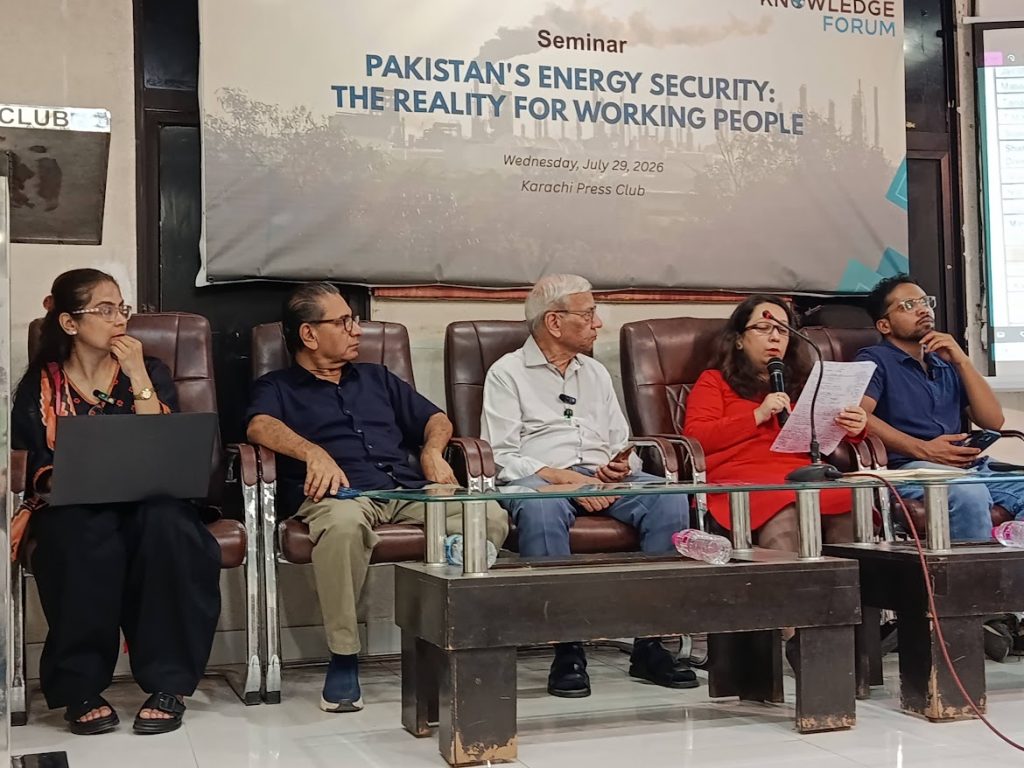
The Knowledge Forum (TKF) and the Karachi Union of Journalists (KUJ) jointly organized seminar, titled “Pakistan’s Energy Security: The Reality for Working People,” at the Karachi Press Club on Wednesday, July 29, 2026.
Speakers included senior economist Dr Kaiser Bengali, public finance and poverty policy expert Sadya Siddiqui, and climate and energy policy expert Basil Andrews.
The speakers at a seminar on Pakistan’s energy security have called for affordable solar power, climate-resilient energy policies and financial support for low-income households, saying that rising electricity costs, extreme heat and unreliable power supplies are worsening economic hardships for working people.
Dr Kaiser Bengali, a former adviser to the chief ministers of Sindh and Balochistan and the architect of the Benazir Income Support Programme, criticised the government’s response to economic and energy challenges. He said governments should provide relief during crises instead of increasing the financial burden on citizens through additional taxation.
Citing international examples, he recalled that Australia reduced taxes during the Gulf War to protect people from rising costs. He also questioned the increase in petroleum prices during a recent regional conflict, arguing that Pakistan’s existing fuel reserves, purchased at lower international prices, could have provided room to delay or reduce domestic price increases.
Sadya Siddiqui highlighted deep regional inequalities, saying Sindh faced greater income inequality than other provinces. According to figures from the Economic Survey 2024-25, inequality stood at 35.9 per cent in Sindh, compared with 32 per cent in Punjab and 26 per cent in Balochistan.
She said recurring heatwaves and floods placed additional pressure on Sindh’s finances, forcing the provincial government to spend heavily on rehabilitation after disasters. Climate change had also emerged as Pakistan’s biggest economic risk, requiring climate considerations to become part of economic planning under the International Monetary Fund programmes.
Siddiqui pointed to unequal access to electricity and solar energy, particularly in hot and economically disadvantaged areas such as Jacobabad and Tharparkar, where access to reliable grid electricity and household solar systems remains limited.
Basil Andrews said energy planning focused primarily on the national grid had failed to ensure affordable and reliable electricity for everyone. He noted that the poorest households spent more than 60 per cent of their income on electricity and cooking fuel.
He said rising solar adoption largely benefited higher-income households, while poorer families could afford neither expensive grid electricity nor the initial cost of installing solar systems. In Karachi, vertical housing development further restricted access to rooftops needed for solar installations.
Dr Bengali proposed a soft-loan programme to help low- and middle-income families purchase rooftop solar systems. He said solar energy offered an affordable long-term solution while reducing dependence on imported fossil fuels.
He also called for improved town planning, better ventilation and rooftop cooling to reduce energy demand. He proposed limiting petrol consumption to 150 litres per vehicle monthly, arguing that excessive fuel consumption by luxury vehicles increased costs for ordinary citizens.
Participants stressed that energy policies must reflect people’s social and economic realities. They called for greater use of solar power and battery storage, reduced reliance on expensive independent power producers, and energy planning that prioritises public health, livelihoods, women’s wellbeing and climate resilience.


