
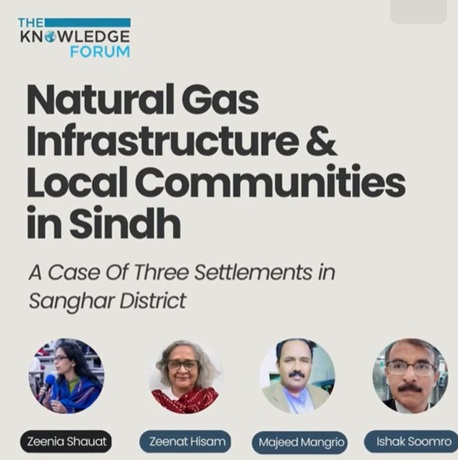
The Knowledge Forum organised the webinar to launch a research study Natural Gas Infrastructure and Local Communities in Sindh: A Case of Three Settlements in Sanghar District on March 21, 2022.
Speakers the provincial government to protect local people from pollution emitting from gas fields and spend funds provided by exploration companies on the welfare of the locals. They underlined the need for the mobilisation of local communities for the protection of their rights.
The lead researcher, Zeenat Hisam, pointed out that despite the fact that there was a legal framework and policy for exploration companies, the local communities were not benefiting from the funds coming for development.
According to her, exploration, drilling, extraction and processing of natural gas harm habitat and the communities living in the surrounding areas. Air pollution causes respiratory, cardiovascular and other diseases. People who live near oil and gas-producing areas experience a higher incidence of poor pregnancy outcomes (birth defects, preterm birth, and stillbirth), cancer, respiratory and cardiovascular problems, and asthma exacerbation. There had been documented cases of groundwater contamination, she added.
She said there was no basic health unit (BHU) within the settlements. The communities accessed healthcare services from the BHU located about four to five kilometres away from the village.
She emphasised mobilising local communities for advocacy and pressure-building on the companies to take measures to limit the impacts on biodiversity; minimise water consumption and discharges; reduce damaging air emissions and reduce greenhouse gas emissions to address the risk of climate change through improved energy efficiency in operations.
Speaking on the occasion, researcher Ishak Soomro said it was a common slogan of the government that after the exploration of oil and gas the fate of the area would be changed. However, there was no change in the lives of people despite the discovery of these resources.
He said local people are not provided employments. For the past many years, Sindh is not receiving royalty from the federal government while it is producing over 55 per centof the gas in the country, but the federal government held back the royalty share of the provinces.
Abdul Majeed Mangrio of the Sustainable Development Foundation (SDF) Sanghar said the communities had no voice and only political elites have control over funds.
Other speakers demanded that the Sindh government review the existing legislation, rules and regulations governing social welfare and environmental management in oil and gas production.
They underlined to increase lobby with legislators for requisite amendments in the rules and policies.
They also emphasised advocating adequate disclosure of information from the companies on all aspects, including financial aspects of oil and gas production and Corporate Social Responsibility (CSR) policies.


